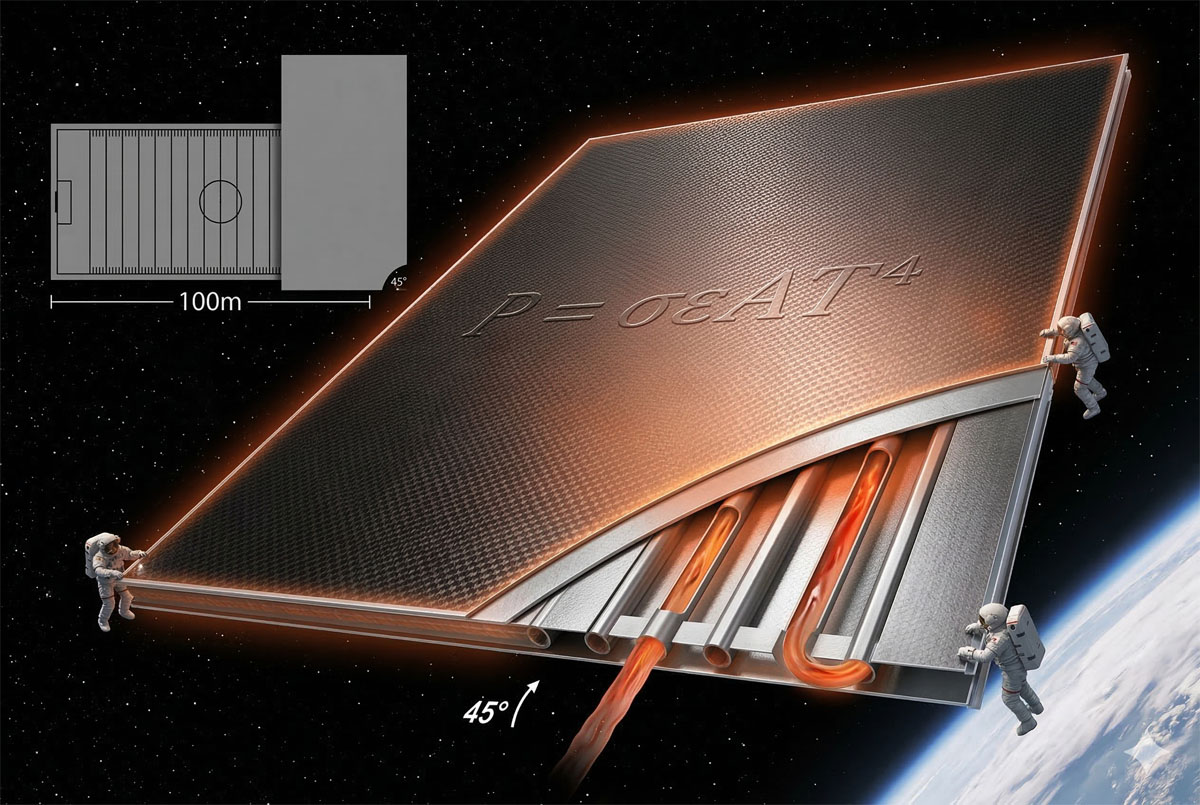
Stefan-Boltzmann — The Reigning Constraint
In the space vacuum, the only way to dissipate heat is infrared radiation. No convection. No water. No air. Only radiators.
A = Radiating surface (m²) → 24,000 m² for 1 MW
ε = Emissivity (0.85–0.95 for black space coating)
T = Radiator temperature (K) → ~350 K for optimal GPU dissipation
To dissipate 1 MW in LEO: 24,000 m² of radiators at 350 K. The ISS uses 51 kg/kW for its radiators. Starcloud-2 aims for 5 kg/kW (×10) — proprietary technology not yet demonstrated in flight.
43 tonnes minimum per MW in orbit (ISS data). That is 25% of the total mass of a 1 MW orbital datacenter. Versus 0 tonnes for a ground datacenter using water or air.
Novembre 2025 : le H100 de Starcloud-1 n'a pas pu tourner en continu. Real overheating on demonstrator satellite. Starcloud-2 (oct. 2026) testera un radiator ×10 efficiency. Johnston : "tbd 😅" sur la masse exacte.
"Radiators, people!! You'll have 100's of thousands of square feet of radiators for these data centers. Just getting those radiator panels up there is four trips lol." — Comment not refuted by Starcloud.
Orbital Radiation — 4nm GPU vs LEO Environment
| Parameter | LEO 500 km | Ground |
|---|---|---|
| TID (Total Ionizing Dose) | 10–20 krad/an | ~0 krad |
| GPU H100 (4nm) sensitivity | ×3 900 vs RAD750 | Reference |
| GPU lifespan with shielding | 2–3 ans | 5–10 ans |
| GPU failure/yr (2025 estimate) | 9% | <0,5% |
| GPU failure/yr (Starcloud-1 actual) | 5% | <0,5% |
| SEU (Single Event Upset) | Frequent | Negligible |
Starcloud-1 measures 5% GPU failure/yr, better than the 9% estimated in models. This improves economics (McCalip: $11.1 Bn vs $16.7 Bn at 5%). But Starcloud-1's nominal mission is only 11 months — behavior over 5 years remains unvalidated in flight.
Tsiolkovsky — The Gravitational Penalty
Transport from the ground surface costs 840× more orbital than terrestrial. This penalty applies to every kilogram: satellites, GPUs, radiators, fuel, SSA sensors, optical terminals.
| Launcher | Customer price/kg | ×ground |
|---|---|---|
| Ground road transport | $0,10 | ×1 |
| Falcon 9 (actuel) | $3 400 | ×34 000 |
| Falcon Heavy (actuel) | $1 500 | ×15 000 |
| Starship (target) | $100–200 | ×1 000–2 000 |
| Starship (SpaceX internal cost) | ~$20 | ×200 |