ADS-B Transponders — Orbital DO-260D
ADS-B NETWORK SAS develops ADS-B/AIS/GPS systems deployed on polar vessels. Our expertise is directly applicable to orbital surveillance.
Aeronautical ADS-B standard adapted for space STM (Space Traffic Management). The FCC and ITU are converging toward a mandate for any constellation >1,000 maneuverable satellites. Cost per satellite: $50K–200K module + integration.
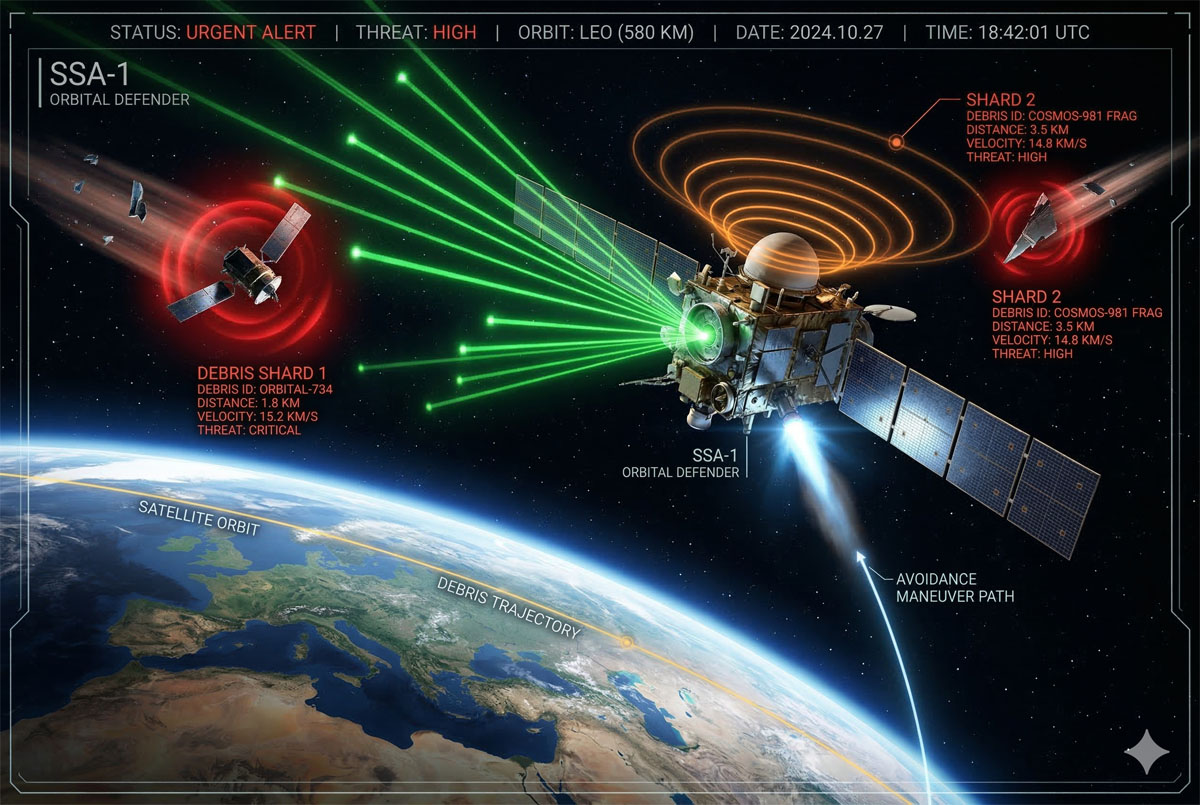
Each avoidance maneuver consumes propellant. More maneuvers = early end of life. Heavier orbital datacenters (radiators + 4 km² arrays) have higher mass = more fuel per maneuver. Not modeled by McCalip.
ToF LIDAR (5–20 kg, $100–500K), FMCW radar (2–10 kg, $50–300K), optical camera (3–15 kg, $100–400K). A complete SSA system: 20–50 kg and $300K–1.2M per satellite. For 88,000 sats: $26–106 Bn.
A 5 GW datacenter with a 4 km² solar array cannot maneuver in an emergency. It is physically comparable to an aircraft carrier trying to make a U-turn in 30 seconds. This satellite becomes a permanent obstacle in its orbital zone. No response from Starcloud to this constraint.
What Starlink Teaches Us About the Reality of Avoidances
| Period | Total maneuvers | Per satellite/6 months | Trend |
|---|---|---|---|
| Dec.2022 – May 2023 | ~25 000 | ~9 | Reference baseline |
| Dec.2023 – May 2024 | 49 384 | 14 | ×2 in one year |
| Dec.2024 – May 2025 | 144 404 | 23 | ×3 in two years |
| Daily average (2025) | ~275/jour | — | Exponential growth with density |
LEO space in 2030 with 88,000 Starcloud datacenters + 42,000 Starlink + 3,200 Kuiper + others = 150,000+ maneuverable objects. The number of potential conjunctions grows in O(n²). The US Space Force already estimates "1 million conjunctions predicted in the following week" at current density. With ×15 more satellites: exponential extrapolation.
88,000 satellites × 5-year lifespan = 17,600 launches/year needed to maintain the constellation. Comparison: ~250 launches/year currently worldwide. Multiply by 70. Even with Starship at 100 flights/year, that means 176 Starships per year dedicated to Starcloud alone.