The Economist's False Claim on Pointing
"The truth is OPPOSITE. Phased array beams are digitally formed and steered — all you need is knowledge of satellite attitude, not control. Optical crosslinks are MECHANICALLY pointed and their large inertias make attitude control DIFFICULT and ESSENTIAL. Given that whopper, why would any sane satellite engineer believe anything else in this article?" — Commentaire LinkedIn public, March 2026.
DIGITAL pointing. No moving parts. The beam is formed electronically by phase shifting. Only knowledge of satellite attitude is required, not precise attitude control. Conclusion: no costly pointing mechanism.
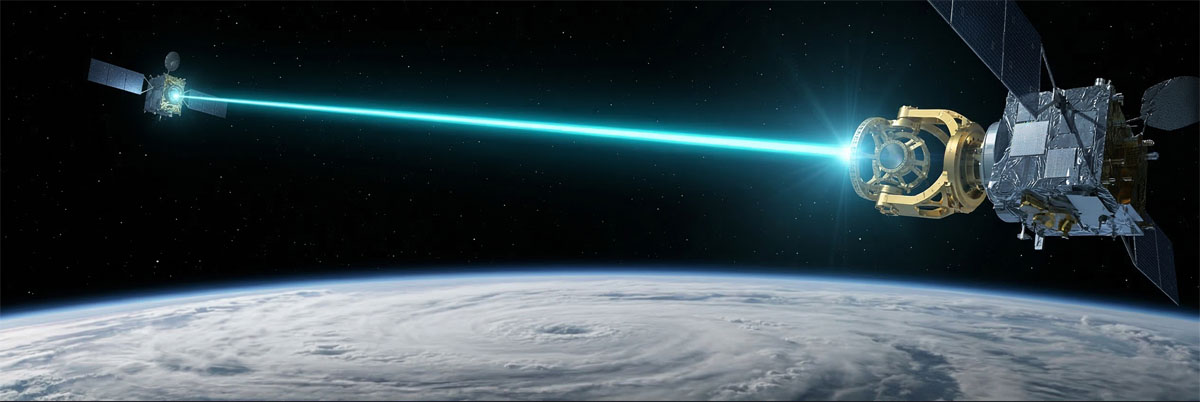
MECHANICAL pointing. Fine actuators. The laser beam must be physically directed toward the moving neighboring satellite. Large mechanism inertia = precise and essential attitude control. Conclusion: pointing cost comparable to or greater than phased-array.
Direct consequence: the mass economy assumed by Starcloud (without phased-array antennas = cheaper satellites = $5/W) is partially negated by the mechanical pointing systems required for laser links. Johnston's $5/W is likely underestimated. Glenn Zorpette (IEEE Spectrum): the Economist article relies on a single non-neutral source and no independent validation.
Atmospheric Attenuation — The Ignored Factor
Ground-space optical links are blocked by clouds. Unavailability rate: 20–50% depending on latitude and season. Paris: ~60% annual cloud cover.
Redundant ground station network in clear-sky areas (deserts). Cost: ×3 to ×5 the number of stations. Or RF backup (×100 reduced throughput). KSAT solved this with its 40 sites — but at the cost of a global network.
KSAT is launching its own LEO constellation "Hyper" precisely to solve the periods without ground station coverage. This is proof that the problem is real and unsolved.
Space Nuclear Reactors — Good Idea, Wrong Timing
| Obstacle | Detail | Assessment |
|---|---|---|
| 1967 Outer Space Treaty + 1992 UN Principles | Art. IV prohibits WMDs in orbit. Civil reactors are in a legal grey zone — each launch requires international negotiation | 🔴 Major political risk |
| Radioactive debris | Cosmos 954 (1978): nuclear contamination of Canada. A failed orbital reactor = permanent radioactive waste in LEO | 🔴 Unacceptable without guaranteed deorbiting |
| Self-irradiation shielding | The reactor irradiates neighboring GPUs. Mandatory shielding = additional mass = counterproductive for mass economy | 🔴 Physical paradox |
| Current power (NASA Kilopower) | 1–10 kW per unit. A datacenter needs MEGAWATTS. 1 MW = 100–1,000 Kilopower units | 🔴 Insufficient scale |
| Orbital reactor maintenance | Nuclear reactor not maintainable in orbit. Lifespan 5–15 years. Same problem as GPUs | 🔴 Maintenance impossible |
| Space SMR cost | eVinci (Westinghouse ground): $50–200M/unit. Space = ×10 minimum. For 1 MW: $5–20 Bn | 🔴 Prohibitive cost |
Space nuclear reactors of 1–10 kW to power crewed space stations or lunar missions — yes. For datacenters requiring MW in object-populated LEO — no, with current legal and technical constraints. The realistic horizon for a datacenter-scale space SMR is 2035–2045.