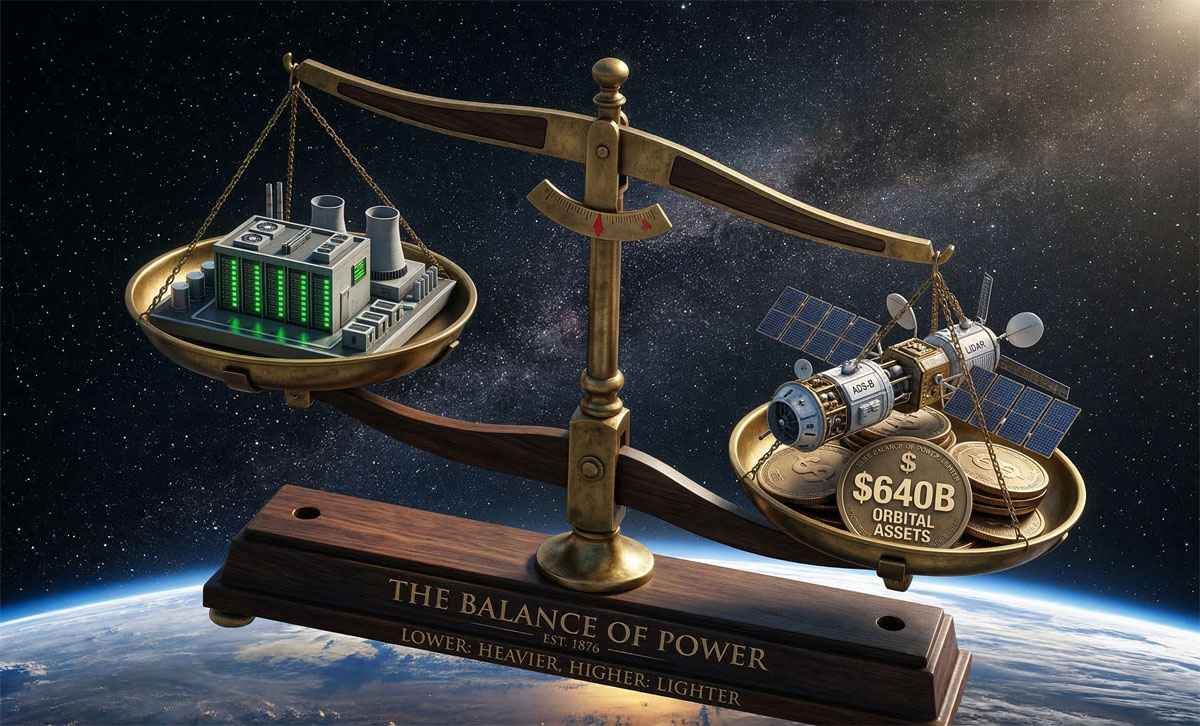
What Has Changed, What Has Not
🔴 Confirmed / Unchanged
- ✅ Stefan-Boltzmann: 43t radiators/MW — confirmed by Starcloud-1 overheating
- ✅ Baseline ratio 3:1 to 4:1 — consistent across McCalip, Zaree, IEEE Spectrum
- ✅ Maintenance impossible in orbit — RTO 6–18 months
- ✅ Large-scale LLM training not viable (GPU sync latency)
- ✅ US CLOUD Act blocking EU/GDPR/HDS clients
- ✅ Nuclear SMR: horizon 2035–2045, not 2026–2030
⚠️ Nuanced / Revised
- ⬆️ GPU: 5% actual failure/yr (vs 9% estimated) — better, not solved
- ⬆️ Parity horizon: 2028–2030 theoretical (if 3 conditions) vs initial 2040–2045
- 🆕 Optical pointing error (RAND Corp) — underestimation of Johnston's $5/W
- 🆕 Hidden costs ($75–640 Bn) — erase Economist parity
- 🆕 Inter-satellite hub = viable short-term niche (2026–2028)
- 🆕 KSAT "Hyper" — Starcloud lead window limited to 2–3 years
Physics, Economics and the Market Speak
"Physics no longer says absolute NO. Economics says MAYBE, under conditions. SLAs say NO to the premium market. Hidden costs (ADS-B, debris, fuel, links) erase theoretical parity. The only short-term viable market is satellite edge inference and the relay hub for defense/sovereignty clients. The rest is marketing."
Laurent Duval · CEO ADS-B NETWORK SAS · March 2026
Johnston: "anything you can do in a terrestrial DC". The Economist: parity at +5%. SpaceX: "competitive in 2–3 years".
McCalip: "physics doesn't immediately kill the idea, but the economics are brutal". Conditions: Starship + 40% solar + GPU 5 years.
SAR edge (Capella Space): demonstrated. US defense relay hub (In-Q-Tel): probable. 99.99% enterprise cloud: impossible before 2032 at best.
The Real Addressable Market vs Projections
| Segment | Estimated TAM | Orbital feasible (current tech) | Realistic horizon |
|---|---|---|---|
| Satellite edge compute (SAR, EO) | $1–5 Bn | ✅ Demonstrated Starcloud-1 | 2026–2028 |
| Inter-satellite relay hub | $500M–2 Bn | ✅ Feasible with laser links | 2026–2028 |
| US sovereign compute (defense) | $10–50 Bn | ⚠️ If In-Q-Tel / DoD | 2027–2032 |
| Non-real-time batch inference | $5–20 Bn | ⚠️ Partial depending on latency | 2027–2030 |
| General enterprise cloud (99.99% SLA) | $300+ Bn | 🔴 Incompatible SLA | 2035+ si jamais |
| Frontier model training (GPT-5+ scale) | $50–200 Bn | 🔴 GPU sync latency | Not foreseeable viable |
"A FLOP is a FLOP, it doesn't matter where it lives. [SpaceX] can just scale until [it] hits permitting or capex bottlenecks on the ground, and then fall back to [their] space deployments." — TechCrunch, Feb. 2026. Orbital datacenters will be a complement to ground datacenters, not their replacement.