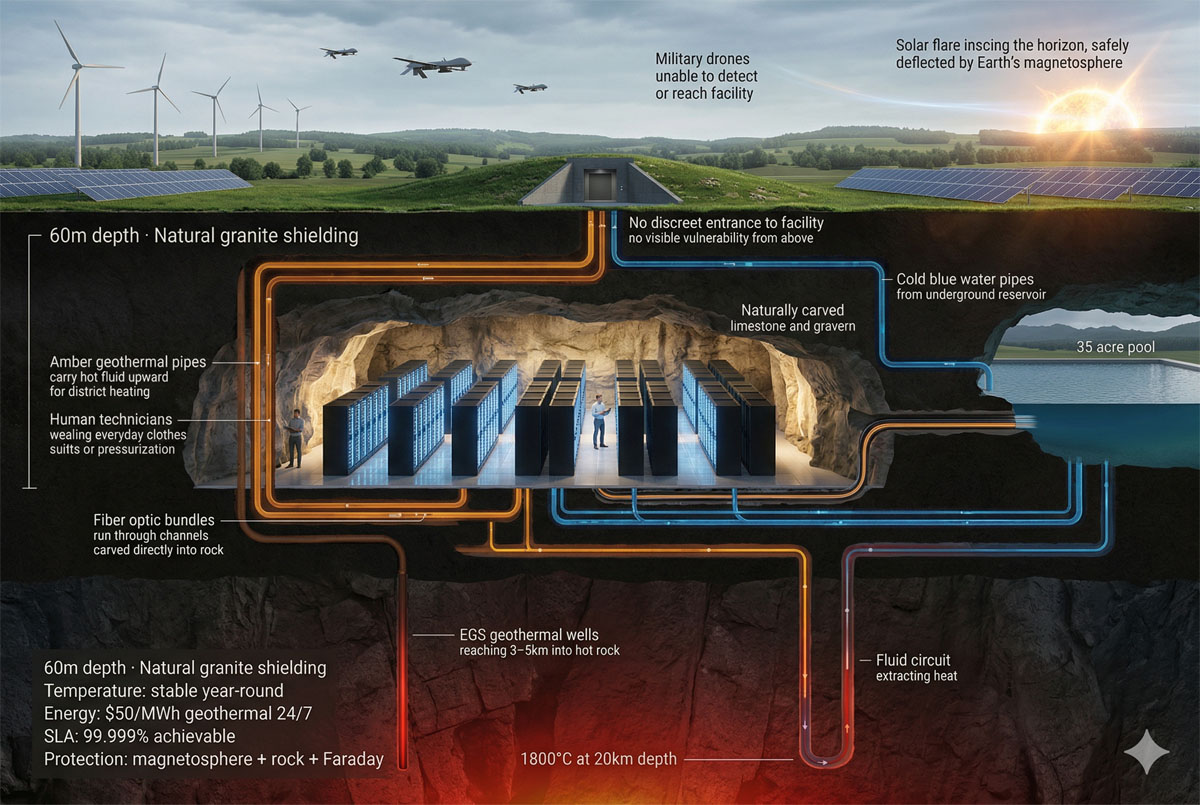
The Solution Already Operating — Iron Mountain, Boyers PA
60 metres underground in a former limestone mine. 35-acre water reservoir for cooling. Year-round stable temperature. Operational today.
Located 60m underground in former limestone mine, Boyers, Pennsylvania. Contains a 35-acre underground water reservoir. Year-round low ambient temperature + constant water level. Geothermal cooling: reservoir pumps + heat exchangers + building loop. Tier 3 Data Center Design Standards. Reduced energy, improved security, increased reliability.
Natural thermal stability eliminates 40% of cooling energy cost. Magnetosphere + rock = full solar and EMP protection. No drone/missile vulnerability. District heating valorisation of waste heat. Rainwater and groundwater for cooling. 50+ year facility life.
Underground Risks — Full Honesty
An honest white paper doesn't hide the risks. These constraints are real, known, standardised — and manageable.
| Risk | Severity | Managed? | Method |
|---|---|---|---|
| EGS induced seismicity | Medium-High ⚠️ | Yes — with protocol ✅ | Traffic-light protocol, 5km geological study, 30yr seismic history |
| Post-injection seismicity | Medium ⚠️ | Partial ⚠️ | Real-time monitoring, automatic stop thresholds |
| Groundwater infiltration | Low ✅ | Yes ✅ | Waterproofing + active drainage |
| Subsurface gas corrosion | Low ✅ | Yes ✅ | Adapted materials + ventilation |
| Radon (granite substrates) | Low ✅ | Yes ✅ | Mandatory detection + ventilation |
| Long-term thermal stability | Low ✅ | Yes ✅ | Geotechnical study required |
The Soultz-sous-Forêts EGS site has operated for 30 years without major incident. The DOE Protocol for Induced Seismicity defines a traffic-light protocol with automatic stop thresholds. To date, no project following this protocol has caused earthquakes felt by local populations. These constraints are known, standardised, and manageable — not comparable to the permanent irreparable exposure of space assets.
Underground vs Surface vs Space — Full Comparison
| Criterion | Surface DC | Underground + EGS | LEO Orbital |
|---|---|---|---|
| Energy cost | $60–120/MWh grid ⚠️ | ~$50/MWh geothermal ✅ | Solar + cooling crisis ❌ |
| Cooling cost | 40% of total energy ⚠️ | Natural passive ✅ | Vacuum radiation only ❌ |
| Solar protection | Grid surge risk ⚠️ | Magnetosphere + rock ✅ | Full exposure ❌ |
| Drone/military protection | Vulnerable ❌ | Protected ✅ | N/A ✅ |
| Waste heat valorisation | Partial ⚠️ | District heating ✅ | Impossible ❌ |
| Maintenance | Technician 30 min ✅ | Technician 30 min ✅ | Impossible ❌ |
| 99.999% SLA | Achievable ✅ | Achievable ✅ | Impossible ❌ |
| Climate resilience | Flooding, heat waves ❌ | Stable — immune ✅ | N/A ✅ |