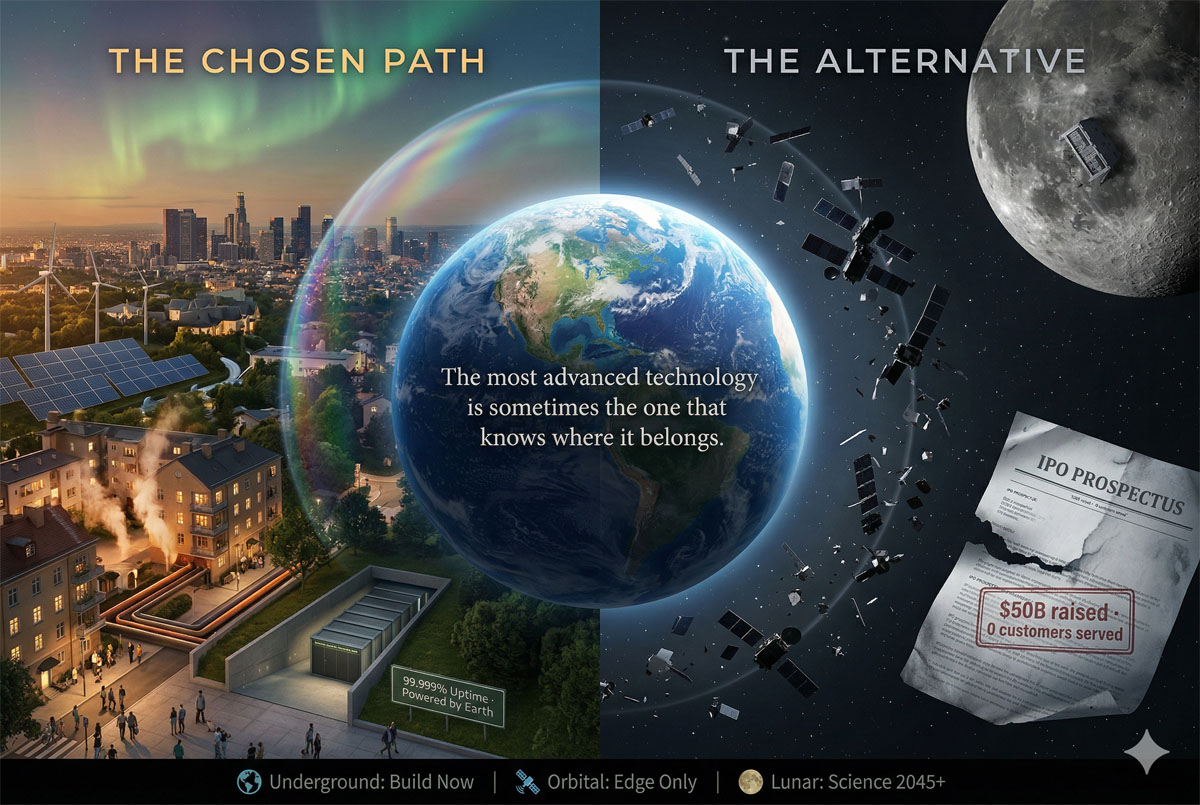
The Verdict — Physics, Economics and Common Sense
TERAfab is spectacular. The physics is non-negotiable. The verdict is clear.
Action Items by Stakeholder
Require full lifecycle cost models: TMR, constellation refresh (2–3 yr), debris management, SLA absence, Kessler risk quantified. Require explicit GPU/MRAM renewal cycle modelling — economic obsolescence at 2–3 years vs physical lifespan at 5–6. Prioritise underground geothermal before any space investment for mass-market. Commission legal analysis on orbital asset liability before signing any space colocation agreement.
Establish binding international orbital data exchange protocol (fuel, health, trajectories) under ITU supervision. Condition mega-constellation licences on funded debris removal plan. Develop commercial liability framework for private space assets independent of 1967 Treaty. Require critical materials impact assessments (In, Ta, Ge, Co) for any constellation exceeding 10,000 satellites. Invest in national EGS geothermal programme for critical infrastructure energy security.
Publish 25-year comparative TCO studies: orbital vs underground geothermal, explicitly modelling the GPU/MRAM renewal paradox. Develop rad-hard qualification protocols compatible with 7–10nm nodes. Publish peer-reviewed critical raw material (In, Ta, Ge, Co) consumption assessments for various constellation refresh scenarios. Continue lunar lava tube research for scientific hosting — without commercial rush.
Develop actuarial frameworks for orbital asset risk: distinguish Kessler-triggered total loss, solar CME damage, and scheduled decommissioning. Quantify the insurability threshold for GPU refresh cycle transition periods in a 1M-satellite constellation — currently assessed as not insurable. Engage ITU and national space agencies to establish minimum technical standards (remaining propellant, collision avoidance capability) as preconditions for any future orbital SLA liability product.
What Version 2.0 Adds: The Lifecycle Verdict
Version 1.0 identified the physics. Version 2.0 quantifies the economics of time. The result is more damning.
| Argument | v1.0 Status | v2.0 Addition |
|---|---|---|
| Radiation constraints | Established ✅ | Confirmed — 100–400 mSv/yr LEO vs <1 mSv underground |
| Kessler risk | Established ✅ | NEW: 40,000 maneuvers/day quantified — fuel exhaustion before hardware failure |
| SLA impossibility | Established ✅ | NEW: GPU refresh cycle creates uncharted SLA transition events — no legal framework |
| Rad-hard memory gap | Established ✅ | NEW: MRAM supply gap quantified — 4 orders of magnitude — market does not exist |
| GPU/MRAM lifecycle paradox | Not in v1.0 ❌ | NEW: 2–3yr economic cycle vs 5–6yr physical lifespan = permanent capital destruction |
| Raw materials finite supply | Not in v1.0 ❌ | NEW: In, Ta, Ge, Co — geopolitically concentrated, unmodelled in all FCC filings |
| Starship launch math | Not in v1.0 ❌ | NEW: 25,000 flights/year for 100 GW = 362× currently approved capacity |
| Insurer recommendation | Not in v1.0 ❌ | NEW: Actuarial framework required before any orbital SLA product can exist |
The challenge of our generation is not to colonise space for data storage. It is to intelligently manage what we have already built, to avoid repeating in space the organisational failures we have not yet corrected on Earth, and to build infrastructure that is resilient to the real threats of this century: climatic, military, and solar. The most advanced technology is sometimes the one that knows where it belongs.