The Question Nobody Asks the Space Dreamers
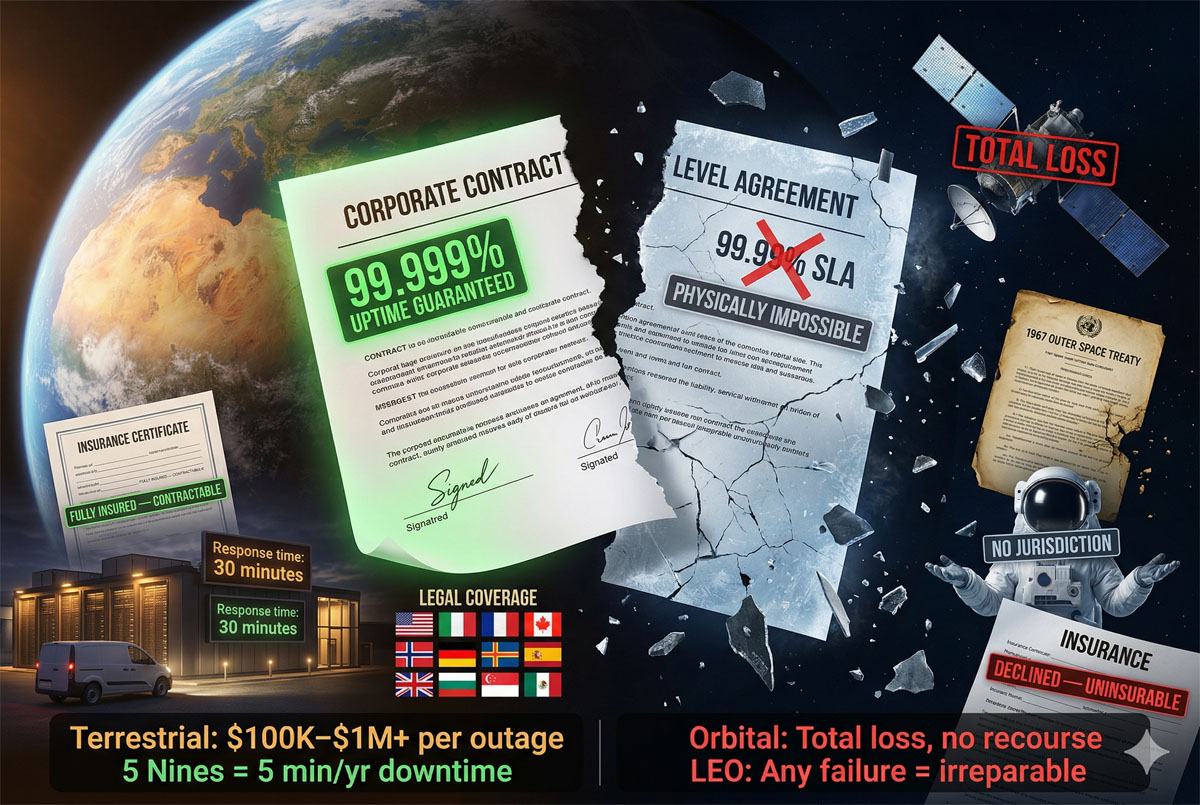
Which operator can sign a 99.99% SLA on an orbital or lunar asset? The answer is simple. And it ends the conversation.
| Failure Scenario | Terrestrial Underground | Orbital LEO | Lunar |
|---|---|---|---|
| Memory failure | Rack replacement: 2–4h ✅ | Irreparable ❌ | 6–18 months min ❌ |
| Power failure | N+1 switchover: ms ✅ | Potential total loss ❌ | No operational power plant ❌ |
| Critical overheating | Technician: 30 min ✅ | Impossible ❌ | Spacesuit + days ❌ |
| Debris/meteorite impact | N/A ✅ | Total loss, no recourse ❌ | Total loss, no recourse ❌ |
| Major solar flare | Faraday cage + UPS ✅ | Orbital drift + damage ❌ | Full direct exposure ❌ |
| Network outage | Fibre redundancy: instant ✅ | Laser relay: 20–50% cloud blockage ⚠️ | 1.3s latency + relay ❌ |
| GPU replacement (economic refresh) | Modular rack swap: 1–2h ✅ | Full satellite replacement: new launch ❌ | Mission: 6–18 months ❌ |
| Fuel exhaustion (avoidance maneuvers) | N/A ✅ | Uncontrolled reentry or drift: total loss ❌ | Fixed body — not applicable ⚠️ |
| Planned GPU obsolescence (2–3yr) | Upgrade in place: 4–8h ✅ | Replace entire constellation: 18–36 months ❌ | Undefined timeline ❌ |
No international jurisdiction defines commercial liability for loss of an orbital asset. The 1967 Outer Space Treaty assigns liability to the launching state — not the commercial operator. A total loss from a Kessler collision or major solar flare falls under no standard force majeure clause. No insurer today covers a 99.99% SLA on a non-recoverable space asset at commercially viable rates.
Terrestrial Standards vs Orbital Reality
| SLA Level | Downtime / Year | Terrestrial DC | Orbital DC |
|---|---|---|---|
| 99% (two nines) | 87.6 hours | Achievable ✅ | Possible if no failure ⚠️ |
| 99.9% (three nines) | 8.76 hours | Standard ✅ | Single failure = breach ❌ |
| 99.99% (four nines) | 52.6 minutes | Industry standard ✅ | Physically impossible ❌ |
| 99.999% (five nines) | 5.26 minutes | Achievable underground ✅ | Not applicable ❌ |
According to the Uptime Institute 2024 survey, 54% of terrestrial operators reported that their last significant outage cost more than $100,000, with one in five exceeding $1 million — on Earth, with technicians available within hours. In space, that million becomes a total loss with no recourse, no technician, and no enforceable SLA.
The GPU Refresh Cycle: An SLA-Breaking Scheduled Event
Beyond random failures, orbital datacenters face a structural SLA problem unique to space: planned obsolescence requires full constellation replacement — with no notification obligation and no legal framework.
When a terrestrial datacenter replaces hardware, it notifies customers, maintains SLA continuity, and migrates workloads. When a 1-million-satellite constellation refreshes every 2–3 years, it deorbits the old constellation and launches a new one. What is the SLA during the transition period? Which jurisdiction governs the notification obligation? No pitch deck has answered this question.
Insurance markets are the ultimate arbiters of SLA viability. No insurer currently offers: (1) orbital asset non-performance SLA coverage, (2) Kessler collision loss-of-constellation coverage at commercially viable rates, (3) solar CME event coverage for LEO compute assets, or (4) GPU refresh transition period SLA coverage. The insurance gap is not a paperwork problem. It is a physics problem in contractual form.
| SLA Requirement | Underground DC | Orbital DC — Current State |
|---|---|---|
| Uptime guarantee (99.99%) | Contractable, insurable ✅ | Physically impossible ❌ |
| Penalty clause enforceability | Standard commercial law ✅ | No jurisdiction — 1967 Treaty ❌ |
| Kessler collision coverage | Not applicable ✅ | No insurer, no framework ❌ |
| GPU refresh transition SLA | Planned maintenance window ✅ | Full constellation swap — uncharted ❌ |
| Solar CME event SLA | Faraday cage + UPS (covered) ✅ | Orbital drift + damage — no coverage ❌ |
| Fuel depletion event SLA | Not applicable ✅ | Uncontrolled reentry — no coverage ❌ |
| Customer notification obligation | Standard GDPR + contractual ✅ | No international framework ❌ |